About Us
Our mission is to grow in faithfulness to Jesus Christ, nurturing a vibrant and welcoming community that embraces all with open arms.
Our Values
Our Vision:
St. Andrew’s envisions a community where all find rest and welcome as soon as they come in, where people experience a taste of grace in renewed relationship and encounter with God through Jesus, the Christ. Transformed by love unbounded and unleashed, we return to our lives, empowered to serve our God by uplifting our neighbor. Drawn back through fellowship, we repeat, returning for sanctuary and renewal again and again.
Our Beliefs
The Episcopal Church is a Creedal tradition, which means that rather than having expectations or requirements of what we think you ought to think, we find our unity through the framework expressed in the Nicene Creed. We invite all to join us in trusting and emulating Jesus, boldly and passionately living as faithful witnesses to our loving, compassionate, and generous God
The Trinity
“We Episcopalians believe in a loving, liberating, and life-giving God: Father, Son, and Holy Spirit. As constituent members of the Anglican Communion in the United States, we are descendants of and partners with the Church of England and the Scottish Episcopal Church and are part of the third largest group of Christians in the world.”
Father (Creator)
We trust, follow the teachings of, and seek to emulate Jesus of Nazareth, also known as the Christ, whose life, death, resurrection, and ascension saved the world from sin and united all that is within the embrace of our loving and generous God.
Jesus: Son of God and Savior (Redeemer)
We trust, follow the teachings of, and seek to emulate Jesus of Nazareth, also known as the Christ, whose life, death, resurrection, and ascension saved the world from sin and united all that is within the embrace of our loving and generous God.
Spirit: God’s Breathed Presence (Sustainer)
We trust, follow the teachings of, and seek to emulate Jesus of Nazareth, also known as the Christ, whose life, death, resurrection, and ascension saved the world from sin and united all that is within the embrace of our loving and generous God.
What to Expect at Saint Andrew’s
Welcome! We're glad you're here! We hope you'll look at the information provided on this page to help you get to know a little bit about us and how we worship. If you have any questions, comments, or concerns please do not hesitate to contact us.
Worship in the Episcopal Church
Sunday is traditionally when Episcopalians gather for worship. The principal weekly worship service is the Holy Eucharist, also known as the Lord’s Supper, Holy Communion, or Mass. In most Episcopal churches, worship is accompanied by the singing of hymns, and in some churches, much of the service is sung.
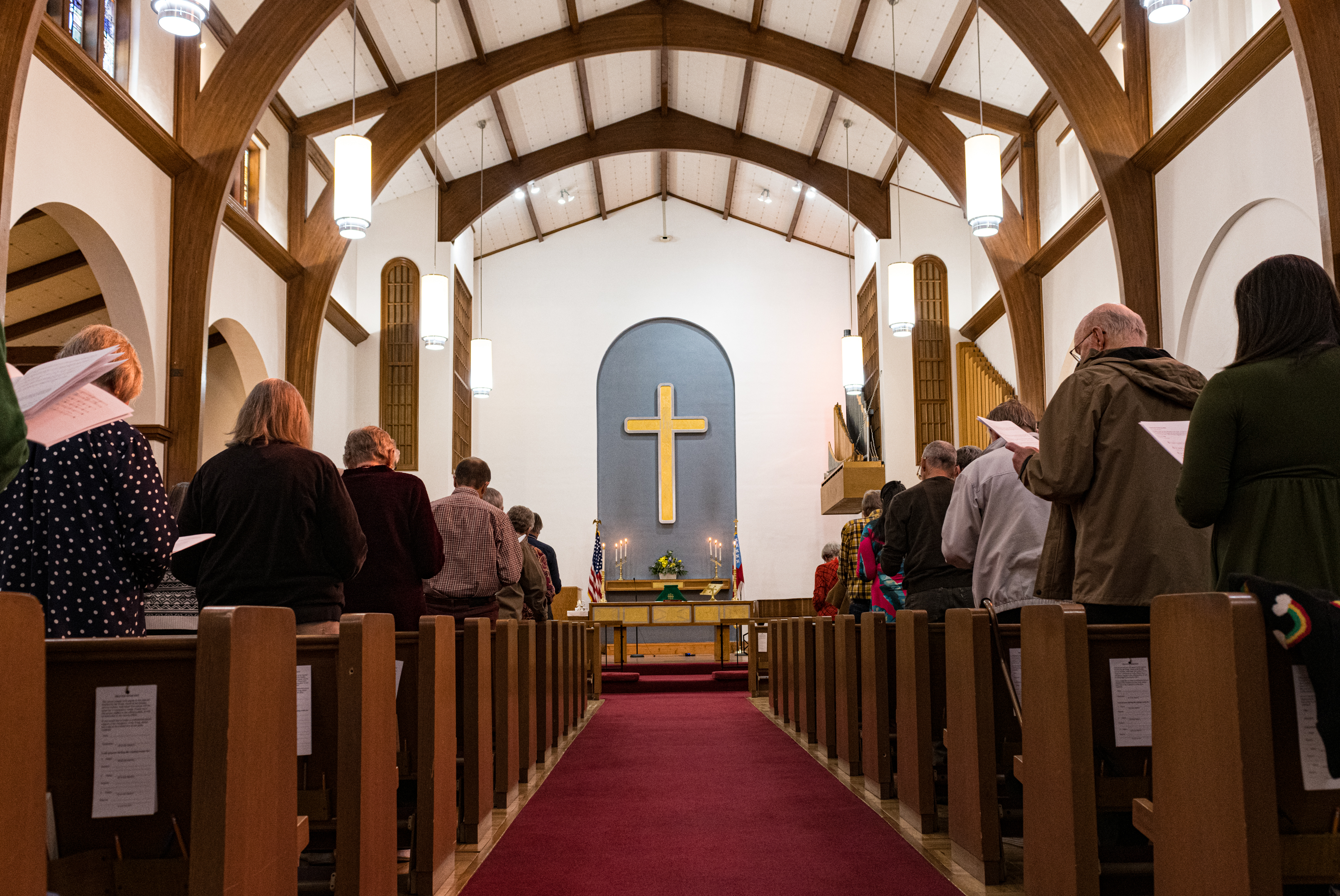
Here at St. Andrew’s, we offer a combination of both styles: We currently offer a 9:30 AM Service on Sundays that alternates between what is known as Rite I, a traditional liturgy, where much of the service is spoken, and Rite II. Rite II offers a choir, a procession, and a variety of service participants. The service is in-person and on Facebook Live.
We have a Welcome table with hosts for newcomers and guests. Our Ushers will also welcome and assist you. They'll be glad to help you find your way around to the restrooms or the Youth Room for classes, and assist you with seating as needed. All ages are welcome at our services. We offer a “prayground” area with puzzles and stuffed toys, and seating for little ones and their parents. We also offer crayons, and coloring pages on request to keep the littlest ones busy.
Our schedule is as follows:
Sundays: Holy Eucharist is at 9:30 a.m. in-person and on Facebook Live.
Tuesdays: Morning Prayer is in-person in Kendrick Chapel at 9:30 a.m.
Thursdays: The Healing Eucharist is in-person in Kendrick Chapel at 12 noon.
All are welcome in our church.
Worship Styles
Episcopalians worship in many different styles, ranging from very formal, ancient, and multi-sensory rites with lots of singing, music, special clothes (called vestments), and incense, to informal services with contemporary music. Yet all worship in the Episcopal Church is based in the Book of Common Prayer, which gives worship a familiar feel, no matter where you go.
Here at St. Andrew’s, our services are what we might call “broad church.” You’ll find our clergy and altar assistants wearing robes and other vestments. Services may be sung on special occasions, but incense rarely, if ever, appears. Our printed service leaflet contains all the readings and hymns necessary to guide parishioners during the services. We also have a weekly Gazette available with announcements of upcoming events and ongoing activities.
The Service: Liturgy and Ritual
Worship in the Episcopal Church might be described as “liturgical.” The Revised Common Lectionary is a three-year cycle of readings that covers most of the Bible (those who wish to follow the historic practice Daily Prayer will read the entire Bible in the course of two years). Most Sundays, there are four readings: one from the Hebrew Bible, a Psalm (also found in the Hebrew Bible), a passage from the New Testament, and a final selection from one of the four Gospels. For the first-time visitor, the liturgy may be exhilarating…or confusing. Services often involve standing, sitting, and kneeling along with sung or spoken responses.
Liturgical worship can be compared with a dance: once you learn the steps, you come to appreciate the rhythm, and it becomes satisfying to continue to engage those patterns, even as the music changes. Many experience our services as deeply spiritual events in harmony with a community of other faithful people.
Eucharistic services regularly contain two distinct sections: the Liturgy of the Word and the Liturgy of the Table. Occasionally a third portion, the Liturgy of the Font (Baptism) appears between the two.
The Liturgy of the Word
We begin by praising God through song and prayer, and then hear from God through our Bible readings. The psalm is usually recited by the congregation either in total or responsively.
Having heard the Gospel, we listen to a sermon, which interprets the readings appointed for the day. The purpose of the sermon or homily is to connect scripture to current circumstances and to challenge each of us to live as God’s faithful Images throughout our week and world.
We then pledge ourselves to God using the words of the Nicene Creed. Adopted in the 4th Century, the Nicene Creed has been the broader Church’s formal statement regarding what and whom we worship and serve.
Following the Creed, the congregation prays together—for the Church, the World, and those in need. We pray for the sick, thank God for all the good things in our lives, and finally, we pray for those who have died. A service leader then concludes with a prayer that gathers the petitions into a communal offering of intercession.
After the Prayers, during most seasons of the Church year, the congregation formally confesses their sins before God and one another. Following this corporate declaration of what we have done and what we have left undone is the absolution, a pronouncement assuring the congregation that God continues to forgive our sins.
The congregation then greets one another with a sign of “peace,” wherein we greet one another and choose to formally set aside grudges and forgive offences that any individual congregant may hold.
The Liturgy of the Font
The Liturgy of the Font is the Baptismal Covenant
This is full initiation by water and the Holy Spirit into Christ’s Body, the church. God establishes an indissoluble bond with each person in baptism. God adopts us, making us members of the church and inheritors of the Kingdom of God. In baptism, we are made sharers in the new life of the Holy Spirit and the forgiveness of sins. Baptism is the foundation for all future church participation and ministry. Each candidate for baptism in the Episcopal Church is to be sponsored by one or more baptized persons.
Sponsors (godparents) speak on behalf of candidates for baptism who are infants or younger children and cannot speak for themselves at the Presentation and Examination of the Candidates. During the baptismal rite, the members of the congregation promise to do all they can to support the candidates for baptism in their life in Christ. They join with the candidates by renewing the baptismal covenant. The water of baptism may be administered by immersion or affusion (pouring). Candidates are baptized “in the Name of the Father, and of the Son, and of the Holy Spirit,” and then marked on the forehead with the sign of the cross. Chrism may be used for this marking. The newly baptized is “sealed by the Holy Spirit in Baptism and marked as Christ’s own for ever.” When all baptisms have been completed, the celebrant and congregation welcome the newly administered within the eucharist as the chief service on a Sunday or another feast.
The Catechism notes that “Infants are baptized so that they can share citizenship in the Covenant, membership in Christ, and redemption by God.” The baptismal promises are made for infants by their parents or sponsors, “who guarantee that the infants will be brought up within the Church, to know Christ and be able to follow him”. Baptism is especially appropriate at the Easter Vigil, the Day of Pentecost, All Saints’ Day, or the Sunday following, and the Feast of the Baptism of our Lord (the First Sunday after the Epiphany).
The Liturgy of the Table
The liturgy of the table opens with the Offertory, wherein a member of the altar party receives the bread and wine, gifts we receive from God, transforms through creativity, and then gratefully returns to God, and sets the table. The banquet prepared, the presider, whether priest or bishop, raises their hands and greets the congregation, saying “The Lord be With You.” Having received response and authority from the congregation to proceed, the priest begins the Eucharistic Prayer, in which we recall the story of God’s work in the world from the beginning of Creation, through the choosing of Israel to be God’s people, and despite our continual turning away from God. After recognizing God’s ongoing call for us to return, the presider tells the story of the incarnation of Jesus Christ, focusing on the night before his death, in which he instituted the Eucharistic meal (communion) as our continual remembrance of him.
The presider blesses the bread and wine, asking for God’s sanctification, after which the congregation recites the Lord’s Prayer. Finally, the presider breaks the bread and offers it to the congregation, as the “gifts of God for the People of God.”
The congregation then shares in the consecrated bread and the wine. At St. Andrew’s, Ushers assist in directing parishioners by rows to move forward to the altar rail, where we stand or kneel to receive Communion.
The Sign of the Cross:
An ancient Christian gesture wherein a person touches the forehead, heart, left shoulder, and right shoulder, and back to the heart, crossing oneself is entirely voluntary. By crossing ourselves, we recognize our connection to the sacrifice Jesus made for us, recall his five wounds, and renew our commitment to maintain God’s presence in our minds, bodies, and spirits. You may watch the priest for cues when to do this action.
All Are Welcome to Receive Communion
God does not discriminate, and no one at St. Andrew’s will be checking cards at the rail! All baptized Christians—no matter age or denomination—are welcome to “receive communion,” should they wish. Episcopalians invite all baptized people to receive, not because we take the Eucharist lightly, but because we take baptism seriously.
Those who are not baptized Christians are welcome to come forward during the Communion to receive a blessing from the priest.
At the end of the Liturgy of the Table, the congregation once more prays in thanksgiving for God’s love and generosity. A deacon or other member of the clergy then pronounces the dismissal, wherein we are reminded to continue our lives of service to God not only in the church building but throughout the World.
How to Dress
Clothing is not optional. Within that framework, you are welcome to dress up or dress casually, according to your preference. We are happy to see you!
Asking Questions About the Service
Our Priest, the Rev. Jonathan Hanneman, and our Deacon, the Rev. Phil Runge, will be delighted to answer any questions you may have and can usually be identified by the clerical collar they wear. If you are interested in exploring the Episcopal Church or becoming a formal member of our denomination, classes are offered periodically during the year to help you with that process. If you are already an Episcopalian and would like to officially join our family here at St. Andrew’s, our office can help you transfer your membership to our parish.
Welcoming Everyone
As the Presiding Bishiop Emeritus, of the Episcopal Church in the United States, Michael Curry said it best: "As the Episcopal branch of the Jesus Movement today, we Episcopalians are committed, as our Prayer Book teaches, to honor the covenant and promises we made in Holy Baptism: To proclaim by word and example the Good News of God in Christ; To seek and serve Christ in all persons, loving our neighbor as ourselves; to strive for justice and peace among all people, and to respect the dignity of every human being." We hope that you will find the people at St. Andrew’s a living example of that statement.
St. Andrew
Andrew the Apostle was born between AD 5 and AD 10 in Bethsaida, in Galilee. The New Testament states that Andrew was the brother of Simon Peter, and likewise a son of John, or Jonah. He was born in the village of Bethsaida on the Sea of Galilee. "The first striking characteristic of Andrew is his name: it is not Hebrew, as might have been expected, but Greek, indicative of a certain cultural openness in his family that cannot be ignored. We are in Galilee, where the Greek language and culture are quite present."
In the Gospel of Matthew (Matt 4:18–22) and in the Gospel of Mark (Mark 1:16–20) Simon Peter and Andrew were both called together to become disciples of Jesus and "fishers of men". These narratives record that Jesus was walking along the shore of the Sea of Galilee, observed Simon and Andrew fishing and called them to discipleship.


Copyright 2026 Saint Andrew's Episcopal Church
All Rights Reserved.